![[PLACEHOLDER — storyteller name]](http://okaricare.com/cdn/shop/files/lp-reason-7.png?v=1780286354&width=120)

I’m standing in my daughter’s kitchen, watching my grandson press silver balls into cupcake icing, and all I can think about is the afternoon eight weeks ago when he asked her mother a question he wasn’t supposed to ask out loud.
It was a Tuesday afternoon on the school run, and I was in the back of the car beside Archie — six years old, strapped into her seat, the windows up against the November cold. Children say exactly what they see, and they never think to whisper it.
“Mummy?” Her voice carried, clear as anything. “Why does Nana smell funny?”
The car went very quiet. “Archie!” my daughter said, too bright and too quick. “That’s not nice — Nana smells lovely.” But I caught her eyes flick to the rear-view mirror, and I saw her hand move, almost without thinking, to the window switch — opening a two-inch gap of cold air beside my head.
For me.
I said nothing. I smiled at the back of my grandson and watched the grey houses slide past, and I felt something I had not felt in sixty-eight years of being a clean, careful, particular woman: I felt ashamed of my own body.
The worst part was that I couldn’t smell it myself
Here is what nobody warns you about. By the time the people who love you start quietly opening windows, you cannot smell it on yourself at all.
I went home and I held the collar of my coat to my face like a madwoman. Nothing. Or — maybe something? Faint, a little greasy, the kind of smell I had spent my whole life associating with other people. Older people. And I could not, for the life of me, tell whether it was really there or whether I was now imagining it on everything I owned.
So I did what I suspect a great many of us do, quietly, alone. I started checking. A discreet sniff at my sleeve before I left the house. Standing half a step back from people. Changing my blouse twice a day. I showered morning and night until my skin was dry as paper — and I still did not know.
That is the cruelty of it. You become the last person in the room who knows.
Then my son sent me the thing that changed everything
He reads everything, my son. He didn’t make a great conversation of it. He simply forwarded me an article and wrote: “Mum, this might be it.”
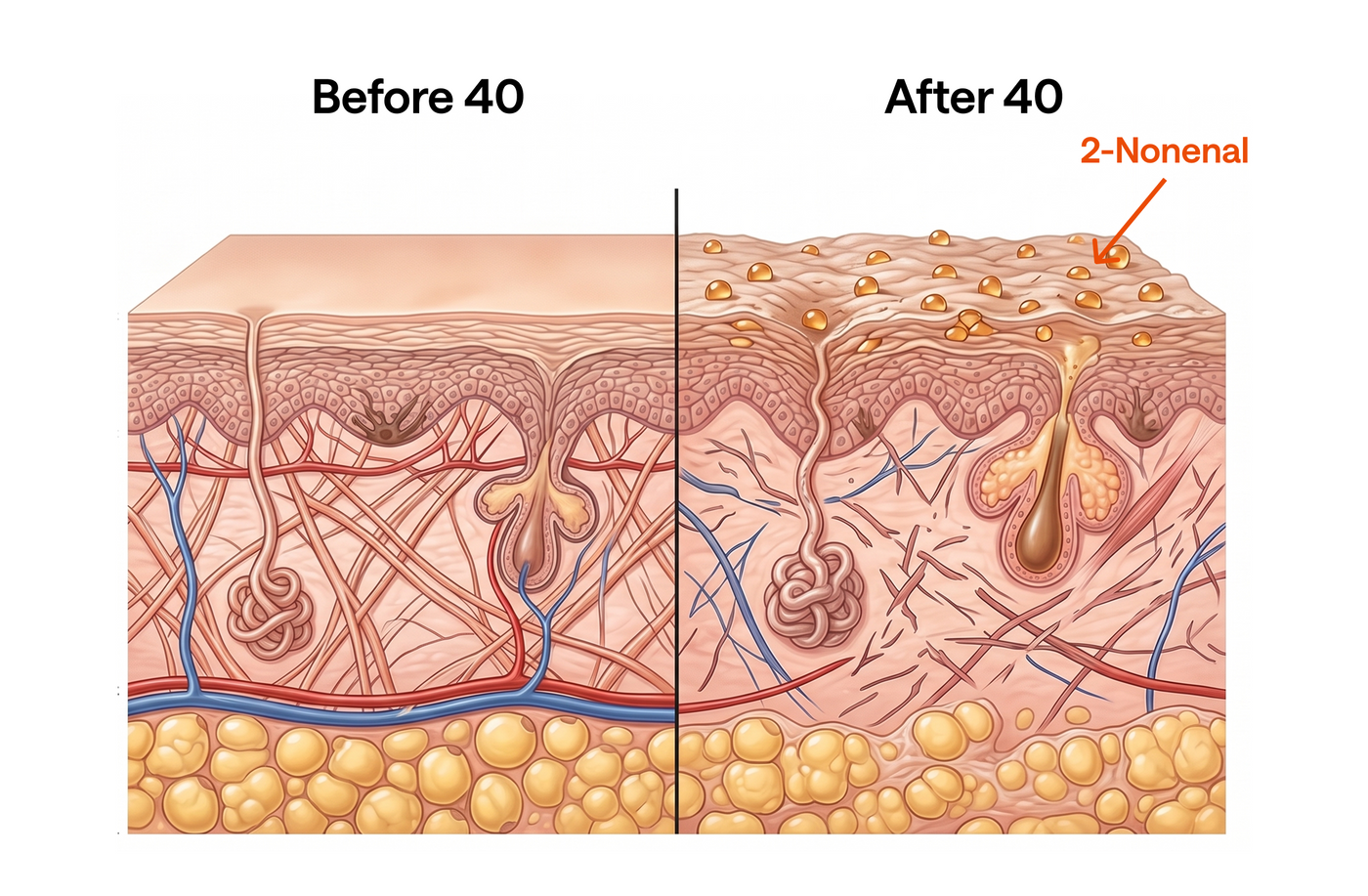
The smell has a name. Nonenal.
As we get older, the oils in our skin change, and they begin producing a greasy compound that simply wasn’t there when we were young. It is not dirt. It is not a hygiene failure. And here is the part that finally explained the last ten years of my life: nonenal is oily — and ordinary soap, every bar and body wash I had ever scrubbed myself raw with, is built to lift sweat and water. It slides straight over the oil. So the smell never washes off. It just transfers to collars and pillowcases and quietly builds.
I sat at the kitchen table and cried. Not from relief — not at first. I cried because I finally understood how long this had been going on, and that all that time the people I loved had been quietly putting up with it. Opening windows. Saying nothing. Sparing me. They had known long before I did, and they had carried it for me without ever letting me see.
What Japan has known for generations
The article led me down a rabbit hole, and the more I read, the more one word kept surfacing: persimmon tannin — in Japanese, kakishibu. For hundreds of years it has been the country’s quiet answer to this exact problem, worked into cloth, fabric and soap precisely because of what it does to odour.
And what it does is the opposite of everything I’d been trying. Ordinary soap lifts sweat and water and slides straight over the oily nonenal. Fragrance just sits on top of it for an hour. Persimmon tannin is a natural astringent that actually bonds to the nonenal molecule itself and neutralises it — on the skin, where it forms, before it can transfer to a collar or a car seat. It doesn’t cover the smell. It removes the thing that makes it.
For the first time, the chemistry made sense to me. Of course nothing in my bathroom had ever touched it — none of it was ever built to do this one specific job.
The only catch was the price. The famous imported Japanese bars sell for around $50 each, and I wasn’t about to spend that on a hunch.
Then I found a dermatologist saying the same thing
I kept digging, because the last thing I wanted was to be taken in by clever marketing. And what finally settled it for me wasn’t an advert — it was a qualified dermatologist and skincare expert, [PLACEHOLDER — real, consenting expert + credentials], recommending this very persimmon-tannin science for ageing skin and the odour that comes with it.
They pointed to one brand that had finally made it affordable and built proper skincare around it: Kaki. The same hero active the $50 Japanese bars rely on, at a price that didn’t feel ridiculous — with collagen, hyaluronate and green tea added so it cares for older skin instead of stripping it.
That was what I’d been waiting for: someone who actually understood skin, not just someone selling soap. So I ordered a single bar. I didn’t tell anyone. I told myself it would be the last thing I tried.
My 30-Day Journey With Kaki
It came faster than I’d expected — on the doorstep within a couple of days. A plain, honest-looking bar. After everything I’d read, I almost laughed at how ordinary it looked sitting in my palm.
I put it in the shower where my old soap used to sit, and I used it exactly the same way. Lather, rinse, done. No routine. No regime. No ten-step anything — I haven’t the patience for any of that, and at my age I shouldn’t have to.
The first thing I noticed had nothing to do with smell. It was my skin. Soft. Not tight and squeaky and stripped the way I’d quietly got used to feeling after a lifetime of scrubbing.
Then came the days I’ll never forget — though at the time I barely registered them.
Day one. Day two. Nothing dramatic. I wasn’t keeping a diary. I was, if I’m honest, braced for disappointment.
Day three. I walked out of the house, halfway down the path, before I realised what I hadn’t done. The little sniff at my sleeve. The pause at the door. I’d simply forgotten to be afraid.
That same week. The small things started. The woman at the post office didn’t take her half-step back. My friend at coffee leaned in, not away. Nobody announced it. Nobody ever does. But I noticed — because I’d spent two years cataloguing the exact opposite. People were just… normal around me again.
And three weeks in, that same granddaughter climbed into the back of that same car, buried her face in my shoulder the way she used to, and stayed there the whole way home.
I won’t tell you a bar of soap gave me my life back. I’ll tell you exactly what it gave me back: I stopped being frightened of getting close to the people I love.
